Saturday, April 19, 2008
Humo

Thursday, April 17, 2008
Home, Home on the Range
On March 29th, about 3 weeks ago, we took a group trip to an estancia, or a working ranch, about a 2 hour drive into the interior of Uruguay. We were planning to have a lot of fun with ample free time to do whatever we wanted to get out of the city and relax in some fresh air and sunshine. We rode bikes around some dirt roads. Branson and I even found some single track through a glade of trees: Mountain Bike Uruguay! Yeah!
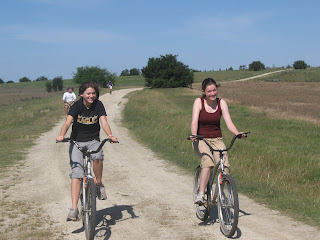 Then we could take either row boats or canoes into the lake on the property. Cody Veteto and I took a canoe around and had fun singing “Kiss de Girl” to the other row boats, attempting to draw a comparison between their row boats and the one in Disney’s Little Mermaid. Sadly, our amazing humor seemed to be lost on the ears of our compañeros.
  Later we had a lunch of really good food with grilled beef and chicken and all types of salad. After lunch, a smaller group of us went out horse back riding and talked our guide into letting us run the horses. He, the guide, took us around the lake and ran us through a narrow strip of trees giving me the feeling of chasing deer or elk through the woods. What a rush! I’ve never loped on a horse for that long of stretch. It was an amazing feeling. Back at the main casa, we swam in the pool and took turns being crazy and throwing each other into the pool. Adding to the entertainment, Hansen Penya, our program director’s 6 year old son, kept wanting us to throw him into the air. Naturally, we Core-Four tried endlessly to get him to flip in the air. We never got it, but he was a good sport! :) At 4:00 we had a Merienda, a type of high tea, with more tasty food. When we were completely stuffed, we boarded the bus back to Montevideo.
 Upon returning, several of us climbers went to a Rock Climbing BBQ that we had been invited to. It was a fun time socializing (in our broken Spanish) with our friends outside of a climbing context. Climbers have to be some of the funnest people I’ve ever made friends with… Although we had eaten all day long, or so it seemed, we ate a lot of food at the barbeque. This included trying some more “exotic” entres: kidney, intestine, and blood sausage. Mrs. McAlister, my 9th grade history teacher, would be so proud of me. None of us cared much for the texture of the kidney or the taste of the intestine, but both were deemed mediocre by those present who had had it before, so I will never know if it actually would be something I’d like or not.
Some future things with the rock climbing club: we have a climbing trip to Minas next weekend and I’ll try to take some pictures of the gym we’ve been going to in order to post them here.
 Hey look! It's a "Watch-Frog"!!!
Saturday, April 12, 2008
I'd like a Mate. Shaken, not stirred.

Now, by popular demand, you get to learn about Mate...
While preparing to go down to
Drinkers of mate themselves aren’t hard to spot either. You see then walking down the street with a thermos of hot water under one arm along with a gourd-looking thing with a metal straw sticking out from it. The calabash gourd, itself called the mate, is usually covered in leather and can be decorated any way that you’d like. The metal straw is called a bombilla and strains the leaves as you drink (seems interesting to drink something hot through a metal straw, but that’s what they do). Also something you would notice are all the leather materas, or “mate bags” that people carry slung over their shoulders to hold their thermos and gourd when not in use.
To emphasize its popularity, I’ll point out that it is the National Drink in
Originally, mate was drunk by the Gauchos of Uruguay and
There are regional differences to mate. In
Another thing that make drinking mate so appealing to me is the sharing culture that goes along with it. Many people drink it alone, but it’s very common to see couples walking down the street with one gourd and thermos between them or to see a group of people sitting in at a restaurant or in front of a house passing a gourd between each other. One person has the thermos and “prepares” the gourd by adding the leaves and the bombilla. Then hot water is poured into a cavity created on one side of the gourd. The preparer takes the first drink to test the preparation/flavor. If it is satisfactory, he refills it with water and passes it to the next person. You have to drink all the water until you make a slurping sound with the straw and then hand it back to the preparer. He will refill it and pass it back until you thank him while you return the gourd. I think it’s pretty cool to be able to share a drink in a community like that.
I don’t think that there is any equivalent in the 
Spring Break Part Four: Some Reflection and Final Day in Peru
Our last day in Cusco was a more relaxing, lazy day due to the intensity of the day before in

The next day began our long flight home. We first flew from Cusco to

It’s really hard to know where to begin on a reflection of this trip. As I’m typing this blog entry I’m sitting in a hotel room in Foz de Iguazu on an amazing

Alone on Putu Kusi, I reflected on another thing: the Incan city of

For some final reflection, I’ll leave you with another underdeveloped thought of mine. I learned a lot about the Spanish conquest of
Spring Break Part Three: Machu Picchu

 The weather added to the effect: we had a mixture of rain, clouds, and the occasional clear view of the entire city. We learned a lot from the tour guide, about which theories regard the purposes of each structure and the different theories on the purpose of the city itself: how it could possibly be a religious center, a place to study the stars, or even an

We boarded the bus once again, for our switch-backed road back down the mountain for a buffet lunch included in our package. We were entertained by live Peruvian music just outside the door and enjoyed a wonderful meal with each other after our soggy morning at

While looking for some other members of the group, we ran into a girl from

Rising at

The views from the top were worth every stinkin’ stone stair we had to climb to reach it. One of most incredible things was the building and terraces built on the top for a sort of watchtower to protect the city. We climbed almost entirely in a cloud and were disappointed we weren’t going to get a view of  was feeling our escapades of the morning and took our time walking back to the main ruins. We were ahead of schedule and allowed ourselves some chill time just sitting and viewing the city and appreciating the awesome-ness of its structures and location. Walking among us and the other thousand tourists in the sanctuary were a heard of wild llamas complete with several young ones. It was very cool to see them walking around the terraces, trying to picture what it all might have looked like when it was flourishing. Then we literally ran back down the mountain (racing the descending busses) and refueled back in town with Snickers bars and generic brand Gatorades. We topped off our incredible day by climbing Putu Kusi and its many ladders. It rained on us the entire time but, once again, we lucked out and the clouds broke for long enough to catch yet another angle on the ruins of
I Got Rhythm, I Got Music
The Wednesday night before we left for
Another Brick in the Wall...Teachers! Leave them kids alone!
Here’s a list of the classes I took:
· Beginning Spanish I & 2
· INTS: Latin American Studies
· Christianity in Culture
· Differential Equations (Guided study)
Beginning Spanish 1 & 2: Studying Spanish in a semi-immersed environment has been a lot of fun. It actually gives you incentive to learn in class because you’re actually going to go out and use the stuff you just learned. We have the class 4 days a week and we really have to work hard to keep up with our crazy teacher Amelia. She is a really great teacher and balances bookwork with oral practice and singing contemporary Spanish songs in class. We also have a Spanish lab where we can practice the vocabulary and grammar and pronunciation in a smaller group context. Many days in lab we learn “scripts” and then have to go out of the house and talk to random people. Very stressful for a introverted person like me, let me tell you. But the people of Montevideo are really nice and all you have to say is that you're learning spanish (Estoy aprendiendo espanol.) and they become really nice and helpful.
INTS: Latin American Studies: This is a class that studies basic structures of culture and the history of Latin America and Montevideo/Uruguay in particular. For assignments we get to go out and explore museums and monuments and statues writing about what we saw and experienced in a journal. Lynette Sharp-Penya, our on-site program director, teaches this class.
Christianity in Culture: This class, taught by Prof. Ken Cukrowski, is teaching us to examine culture while thinking theologically. We’ve discussed issues such as capital punishment, abortion, women’s rights, and homosexuality. It’s been very interesting both to hear the views of other students in my class and to develop my own thoughts and beliefs on these issues. Where culture is concerned, we’re getting a double serving by examining the culture of Uruguay and Latin America and then compare it to our culture back home, often discovering some unfavorable things that we do in our daily lives, especially with regards to our treatment of other people.
Differential Equations: DE has been quite an experience for me and Marissa, the other physics major studying abroad this semester. We had to take the class as a prerequisite to a lot of upper level physics classes that we will have to take in the future, but obviously they don’t offer anything like that down here. So, we are taking it as a guided study, basically teaching ourselves the ins and outs of modeling with differential equations, doing homework on our own, and faxing our tests and quizzes to the professor back in Abilene. It’s been a lot of work keeping up with the class at ACU, but the work will pay off in the long run.
And now next semester I get to look forward to Thermodynamics, Solid State Physics, Math Methods for Physics and Engineering, and Business and Professional Writing. Whew! I'll take back anything I ever said bad about classes in Uruguay...

