Saturday, April 12, 2008

Spring Break Part Two: First Events in Cusco

Because our flight from Lima to Cusco wasn’t extremely early in the morning, we had a nice and relaxing breakfast (consisting of bread, butter, and jam along with an amazing freshly squeezed papaya juice and tea) and packed up our belongings. The flight itself was mesmerizing. I had my face literally glued to the window from the moment we took off until we landed about an hour later. The views, “Oh the Joy!”, were out of this world: tall mountains and glaciers, high grassy plateaus dotted with villages and crossed by roads that looked treacherous on a good weather day. Unbelievable! The views from that flight were worth the trip already and we had just gotten to Cusco…we still had about a week of fun, filled, action-packed adventure awaiting us!
We met our drivers who would take us to our hostel with a little less difficulty than we had in Lima (thank goodness). Along the way to the vans, we were immediately and constantly approached and asked if we wanted to buy things, most notably coca leaves and coca candy. The leaves of the coca plant have been used for an extremely long time (even dating back to the days of the Incas or earlier) for medicinal purposes and for help in high-altitudes. It is suggested that you chew or drink the tea upon arriving in Cusco, since the city itself sits at 12,000 feet. (Can you imagine that as well: we flew into an airport at 12,000 ft. No wonder we got a good view of the mountains we were flying over, they were right underneath us!)

We got to our hostel and were immediately served coca tea which I might say is very good. The view from the upstairs balcony was incredible. You could look out and see the whole valley of the city of Cusco since our hostel was situated on the side of a hill. I’ve already mentioned some of this view before so I won’t go into too much detail. The rest of that day we spent walking around the city, acclimatizing, and setting up tours and adventures for the beginning of the week.
That night, we ate at a little grill down the street from the hostel and I was able to add some more items to my “strange food” list. Everyone ordered a joint cuy so we could all try it. Cuy is a Peruvian specialty and is roasted guinea pig. It didn’t look appetizing at all when it came out, but I didn’t think it was all that bad. I do believe that I am alone in those sentiments however… As my main dish I ordered grilled alpaca, very similar to a llama. It was very tasty, similar in taste and texture to venison. After dinner we had to run back down to the main plaza to talk to the travel agent lady we had found earlier that day and sit through a frustrating session of bargaining with them about prices. They had said one price in the afternoon and had upped it now that we had our money there to pay. It all ended up worth the haggling and the frustrations of the night quickly faded as we climbed back up the hostel (breathing like an asthmatic the whole way) and could see the lights of the city below us. Incredible!
The next day, Sunday, we boarded a bus that took us out to Action Valley, a company specializing in adrenaline sports. They claim to have the highest paintball arena on the planet and offer “sling-shot” rides. However, we had come for the bungee jumping… It is the highest commercial bungee jump platform in the western hemisphere sitting at 122 meters high. When you jump, you free fall a total of 105 meters with a 3 second, un-abated freefall. There were six of us that dared to jump and all six enjoyed ourselves immensely. It’s very difficult to describe the feeling that you have when you jump off a platform at over 400 feet in the air. Lot’s of things go through your mind at once including, “What have you just done?” or “What a cool view.” or “That ground is coming really fast and the wind is bugging my ears.” or “Man, I wish my mom could be here, wait on second thought…” After the first fall though, all your fears are gone and you can enjoy the rest of the ride. Four others in our group also did a really long zip-line and zoomed over our heads at a pretty good clip. The rest of the afternoon was dedicated to more Cusco exploration and souvenir shopping. That night, several of us went in together and cooked our own pasta with red, meat sauce. Very delicious after a hard day acclimatizing. (The daring 6 of us who bungee jumped)
Mondy, we went on a raft trip. Hardly any of our group had every gone rafting before, and what a way to start out rafting through the Andes! Just the drive to get to the put-in was amazing: huge mountains, corn fields, sheep, people spinning yarn in the fields while watching their sheep. The rafting itself very enjoyable and we were blessed to have very good, and fun, guides. They even pulled us over at one point and had us play some “rafting games.” However, right at the beginning we had an accident: on of the rafts didn’t make a corner in the river and got broached, or pinned on a rock. Several fell out and our raft pulled one of them in but the rest were able to remain calm and eventually work themselves off the rock. Our guide also let me take the helm towards the end of the ride and I treated my pals in my boat to some good ol’ fashioned Middle Fork piracy… Back at the rafting headquarters, we had a sauna and a good, hot lunch. Then it was another incredible ride back into town for dinner, some more souvenir shopping, and sleep.

One thing worth mentioning is the Parade of Senor de los Tremblores, or Lord of the Earthquakes. During one of Cusco’s major earthquakes, a crucifix was paraded around the city and as a result the earthquake stopped. Thus, they continue the tradition every Monday of Holy Week in order to protect the city from future earthquakes. The main square was packed with thousands of people standing shoulder to shoulder watching the procession. We couldn’t get through and had to walk a long way around to our hostel after dark. Looking back toward the square at one point, you could see just how big the throng of people was. This is a good illustration of the mix of religions that resulted from forcing Catholicism on the people of South America. You usually got a mix of Catholicism and pagan rituals.
The next day we were on our way to the Lost City of the Incas…

Friday, April 11, 2008

My Peruvian Spring Break Part One: Lima

Our Spring Break excursion started out with class and, once it got rolling, never looked back! On Thursday after lunch we got picked up from the Casa by Remise, a kind of taxi that you can order before hand. We stepped out the door to see 4 jet-black vehicles with our sunglassed and suited drivers awaiting: we felt like we were being driven to the airport by the secret service! The flight itself was uneventful, thankfully, but we did have some trouble in the Lima Airport connecting with the van that was supposed to take us to our hostel. Usually you get something arranged beforehand because the Lima airport is notorious for having taxis sitting outside with bad intentions… We made it safely to our hostel and collapsed into our small, but comfortable beds.

Also important to note, we withdrew some Peruvian currency in the airport. They are called “Nuevo Soles”, or just “soles”. Singular it’s “sol”, or sun, which sounds very similar as one might imagine to the English “soul”. The rest of the trip was filled with puns about people owing each other their souls, or how the dinner cost me my soul. Very entertaining!

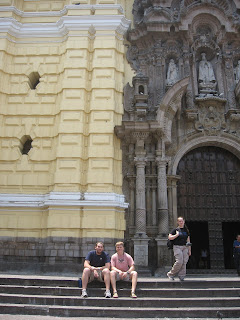
The next day we woke up and took a taxi downtown to the main square, Plaza de Armas, and toured the area. We paid for an English tour of the nearby Franciscan Cathedral which is also famous for the catacombs that lie beneath the building. I don’t think I’ve ever seen an actual human skull in real life before and I couldn’t help but shudder when we were taken by a neatly arranged pile of them. After that we walked back to the Plaza to await the changing of the guard which happens everyday at noon at the government palace located on the main square. Looking around at some of the other churches, we ran into the rest of our group which had stayed in a hotel the night before. The fanfare that goes into the changing of the guard is pretty extensive and I am amazed that they do it everyday. A band comes out and plays and the ordeal involves many soldiers in historic garb high stepping to the beat of the drums. It was also interesting to see the contrast between the historic soldiers and the actual military/police in camo that were guarding the politic area.

For lunch, we walked down toward the Plaza de San Marin looking for a restaurant serving ceviche, or cebiche, a famous Puruvian dish made from raw fish essentially “cooked” or pickled in lemon juice. We found a restaurant on the square itself serving an entre and an appetizer and drink for 6 soles. The fish was very good but had an interesting texture considering it isn’t cooked. After our food adventure, we took a taxi to the Museum of Art. The way they had it displayed was very interesting: you enter to see the pre-Colombian art first and move through history. As the Spanish conquered the area they forced their artistic ideas upon the native artists completely changing their form of expression from ceramics, metal work, and textiles to painting. It continued into modern day artists and it was very cool to see actual works from Peruvian painters.

Once outside, we were greeted by the chorus of car, taxi, and bus horns that were our constant companion while in the city of Lima. I’ve mentioned this before, but the traffic of Lima is supposed to be the craziest in all of Latin America. It was here that we witnessed a man try to slash the tires of a taxi next to him on the road…while driving! Another funny site to see in the streets were human traffic lights. A person would sit/stand on a platform at an intersection and actually direct the traffic.

Later that night, after returning to our hostel for some relaxation before another planned gathering with the entire group, one of my friends, Sarah, and I went out for a walk along the ocean’s edge. Now I didn’t say “beach,” because the shoreline of Lima is kind of interesting. The buildings and path on which we walked are above the beach on a sort of bank. The beach in the Miraflores area (the neighborhood that we were in) is also made entirely of small stones, very different than any other ocean shore I’ve ever been to. As we walked we were able to see surfers in the waves, parachute ride things, a famous park with “Love Mosaics”, and some pretty cool statues. The sunset over the horizon was very beautiful and it was hard to pull ourselves away to go to the next thing.

For dinner we caught a taxi to the hotel our friends were staying at downtown and walked to a nearby Chili’s restaurant for dinner. You have no idea how much people can miss chips and salsa when you go out to eat, but let me tell you, once you don’t have it for 3 months, it’s pretty nice. The food was very good and the atmosphere very conducive to conversation and having a good time. Then, my roommate Mark has a tradition of taking pictures at Starbuck’s coffee shops that he finds in foreign countries that he and his parents travel to. After that, it was back to the hostel for a much needed night of sleep. However, to our dismay, it was even hotter than the night before, and sleep was hard to come by.

Sunday, March 30, 2008

Palacio Legislativo

This past Friday, we took a tour of the Legislative Palace of Uruguay, located here in Montevideo. The building itself is an awe inspiring construction. You’ll have to look up some pictures online (http://www.parlamento.gub.uy/palacio3/p_visitavirtual.asp?Lang=Eng): it commands a large area and its marble columns at one of the entrances are impressive. There aren’t very many buildings in the area that are as built as high either. Its idea was born in the early 1900’s because the Legislature at that time didn’t have any official place to meet. They met in people’s houses and rented buildings for larger events. Actual construction began in 1908 and was overseen by an Italian architect giving the building its distinct design. They finished work in 1925 in time to celebrate the centennial of the country.
If it’s possible, the inside is even more remarkable. The first room that we entered is called something like the “Room of the Lost Steps” and it separates the halls of the Senators and the Representatives. Located in the center of the building, this room has ceilings, artwork, and design fit to be in some of the cathedrals that we have visited. This in itself is interesting when you remember that Uruguay is one of the most secularized countries in Latin America having gone through an extensive process beginning in the 19th century. The tour guide informed us that the
room was constructed entirely from 52 different kinds of marble, all taken from quarries in Uruguay. Above our heads there were also amazingly detailed mosaics (if I hadn’t known they were tiled I would have thought it was a painting!), beautiful stained glass windows imported from a artisan in Italy, and 24 k gold and crystal lamp stands. Next we moved to the ballroom, where everything is original, nothing being restored. The entire room was built with wood imported from Italy and at the center sat a huge Turkish rug and an enormous table carved from one piece of oak. We were also shown the library which is also completely handmade with wood furnishings including bookshelves of a type of rose wood claimed to be the most expensive wood in the world. It’s the 2nd largest library in Uruguay and is open to the public. It was cool for us to see some people actually in the room studying.
After being blow away by the architecture, we followed our guide to the rooms which the senators and representatives meet twice a week. It was kind of surreal to step onto the balcony and look into the area where the politicians sit. I’ve only seen scenes like it in the movies. Uruguay’s system of government is very similar to ours and has had tow major parties like us since its creation: the Red Party and the White Party. Only recently has a 3rd party emerged: the Broad Front, a liberal-socialist type party, which is the party of the current president. As they conduct meetings, the elected officials sit segregated with the older parties on the sides and the new Broad Front party in the middle. In the Representative chamber, there are 99 representatives, most of which are from Montevideo and there is also 1 Independent member elected. I don’t know exactly where he sits during meetings… One thing we noticed, were 2 coasters sitting on each of the desks. When
asked about these, the guide laughed and said they were for coffee and tea. She also said that the members are now allowed to drink their mate during meetings (they hadn’t always in the past) but that they haven’t gained the liberty of having 3 coasters on their desks…
Two more cultural things: First, Uruguay flies three flags in many places. One has a red diagonal on it: this was Artigas’ flag as he fought for independence from Spain. One has the inscription “Libertad o Muerte”, liberty or death: this was used by Lavalleja and the 33 Orientales (roughly “Revolutionaries”) when they returned from Buenos Aires to fight for independence from Brazil. The third is the current flag with alternating blue and white stripes on the right and a sun in the top left-hand corner. Second, the Uruguayan seal or shield is shown in many places. It is split into four sections each with a symbol: (going from top left, counter clockwise) Scales=justice, Horse=liberty, Ox=richness, and The Cerro(the highest point in Montevideo)=strength.

Wednesday, March 26, 2008

The Wild West Should Meet the Original Gaucho

On Sunday, we got opportunity to go to a Uruguayan rodeo and fair. Holy Week, the week before Easter, has been renamed Tourism Week as part of a separation of Church and state process that began the 19th century and as part of last week they put on a week of festivities here in Montevideo. They call it Semana Criolla, roughly translated at Heritage Week. Gaucho (the cowboy of the Southern Cone) culture is a huge part of the Uruguayan tradition and much of it was being celebrated while in different presentations we were able to attend while we were there. First, Ximena (one of our Spanish lab instructors and good friends) took us to see the end of the rodeo part. The riders, dressed in Gaucho wear, would mount a horse tied to a post and ride the bucking bronc swinging their whips above their heads. It probably wouldn’t have been the favorite place of a PETA member, let’s just throw that in there. Then, we walked through an artisan market while looking for some other form of entertainment. We found a magic show/circus in progress and I at least had a very good time watching the proceedings and trying to understand what they were saying. Man it’s hard to come back to Montevideo and hear Spanish after listening to the clear speaking of Peruvians! Then we went to see a song and dance show presenting folk dances and music of the past. It was very fun. Mom, you would have loved it. Other than that, we were able to talk with Ximena about different aspects of Uruguayan culture and share with her some of the funny things that we do in the States that is different than here.

I tried to take notice of the similarities and differences between a fair/rodeo here and back home. Honestly they were very similar. We saw a lot of families spending time together and the smell of hotdog and hamburger stands filled the air. The biggest difference was the lack of games or rides that you would normally find at a fair in the states. It was a relief not to be accosted by carneys every step you took.

Crazy Taxi Drivers and Dog Poo

As I was running this morning, I thought about some interesting things to tell you about city life in Montevideo. We’ll see if I can collect my thoughts:
Trash:
I’ve been taught growing up that you don’t litter and my coaches in High School repeated over and over that they weren’t my mother and therefore were going to make me run if they had to pick up after me. So, upon arriving in Montevideo, they way people treat their garbage was kind of a shock. First, they have dumpsters where we carry our garbage and they are regularly picked up by the city. However, there are a certain “class” of people who live in the outskirts of the city and come around either on bicycles or horses pulling trailers and they sort through the trash for anything that might be useful. This serves as the recycling service as well since they pull out all the materials able to be recycled and turn it in for money. It seems as though this has become a way of life for both them and the rest of the people of Montevideo. Some leave food, usually leftovers, out in front of their houses or hang plastic bags from the trees with stuff that they can use. Also, if you have a plastic or glass bottle, the custom is to leave in on the sidewalk next to the dumpster.
Secondly, people don’t have any qualms about throwing trash on the ground all over the place. You especially see this on the main streets where people are hired to stand out in front of businesses and hand out flyers to passerby. Entire the block around the distributor is littered with the pieces of paper that he or she just handed out. I think the reason behind this is creating jobs. There is a huge unemployment problem in Uruguay and even if you do have a job it’s for very low pay. So, if there is trash on the ground the government can hire workers to clean it up. Everyday that I run through the park close to the Casa, I see workers cleaning up trash from the grass. At the beach as well (I don’t remember if I’ve mentioned this before) they clean the sand of garbage and whatever floats ashore from the river.
Streets:
The traffic is crazy here in South America! It’s very interesting to watch drivers interact with each other via flashing headlights and their horns. As they drive they don’t really give any concern to the painted markings either. If there is a space between two cars you’ll see a driver squeeze through honking all the while to let the others know that he is there. In Peru, we rode in a couple of busses who would pass other vehicles in the strangest places. I think we passed another bus as we went over a speed bump once, so we were both going about 5 miles an hour!
We’ve thought about renting some kind of scooter to get around town faster, but I think I would kill myself! The traffic is crazy, but I’ve never seen such good drivers. They put people in the States to shame with their attention to the task at hand, awareness of the road and other vehicles, and quick response times. I feel more comfortable riding in a taxi here I think than I would in the states. We had a couple of close calls in taxis in Lima, Peru (where the traffic is supposed to be the worst in all of Latin America) but no accidents. We also got to see some road rage in Lima where a man reached out his window and tried to slash the tires of a taxi next to him because the driver wouldn’t let him merge! To be honest I’ve only seen three total accidents while I’ve been here. The first happened in Minas where everyone had the typical small town reaction. It looked as though the entire police force was there directing traffic (all of 2 cars every 10 minutes or so) around the accident and people up and down the street were hanging there heads out windows to see what all the “hubbub” was about. The second was in Cusco where we saw a taxi back into a light pole while trying to turn around in their ridiculously narrow streets and shattered his rear window. The third was this morning while running I saw a motorcycle and a car slide into each other. Both parties were okay and it didn’t look as though there was much damage, but it really surprised me to even see an accident after all the experiences we’ve had.
Sidewalks:
The sidewalks here are one heck of an extraordinary mix of amazing ingenuity and frustrating inconvenience. They aren’t a complete slab of concrete, but instead are made of individual concrete tiles stuck together. It seems like a great idea allowing the roots of trees to grow without breaking the costly sidewalk and when they’ve worked in the water works nearby, all they’ve had to do was pull up the tiles and dig down to the pipes, replacing everything when they were finished. But inevitably as you walk down the street there are broken tiles everywhere, tiles missing, and the tiles put in place but not stuck down. These latter are really annoying after it rains and they seem to float on the surface of a hidden puddle, only to splash your entire lower body when stepped on. There is also the problem of dog poop that one must dodge while walking down the street. This kind of applies to the first category in that we’ve been taught to pick up after our pets in the States. I really don’t know who ends up cleaning up the “sidewalk feces”.

In contrast, people like to take care of their sidewalks. It’s common place to see people outside their home or business cleaning the walk with a bucket of soapy water and a broom or even just sweeping the leaves off into the street. People take pride in having a clean place in front of their respective homes or shops.

Monday, March 24, 2008

La Paloma era muy bonito.

So this is a little behind, but a couple of weeks ago we took a combined trip to La Paloma (along the east coast of Uruguay) and the surrounding area. I liked the picture idea that I had for the climbing trip and BA so that's what I'll do for this one. Here goes:

One the first day in La Paloma, a group of us decided to take surfing lessons. Here are the six guys who braved the cloudy weather and crashing waves to learn the art of surfing.
First part of the lesson included learning to jump up from a lying down position to standing. On the beach it seemed pretty easy, on the board in the water: not so much... I don't have any actual surfing pictures because my batteries died about 2 minutes after this photo. :(
We took a 4x4 ride to a rocky ithsmus called Cabo Polonio and this is the lighthouse that warns ships of the perilous rocks.
We got to hike to some sand dunes just outside of town as well. Here's Branson, Mark, and Holly enjoying the views. It was kind of wierd hiking between the dunes and the surf in the light conditions we had: felt like we were on some strange planet with no life around for miles.
Here are more dunes off in the distance. We hiked to the nearest one visible with the two dots on it in the left side of the picture. The dots in the picture are our resident professor's family Ken, Karen, Krista, and Katie Cukrowski. (I think if you click on the picture it will load in a different window bigger).
A picture of Sarah Boyd and I standing at the top of the lighthouse shown earlier. You could see for miles around (probably because everything was so flat). The four of us up there couldn't do anything else except stand there and take it all in. Gorgeous!

Now here's a fun game. I hope I'm right about being able to click on a picture and loading a larger version in a different frame, because it'll be harder to play without it. Here's the deal. This is a photo from the top of the lighthouse there is a napping kitty-cat on the rocks below. Can you find her? (Hint shown below)
This picture is taken at Punta del Diablo. The waves would come in and crash on the rocks of the point, resulting in amazing photo opportunities. This is Branson in the foreground, one of my hiking buddies you'll hear a lot about in the Machu Picchu Blogs coming soon to a webpage near you.


Lastly, we visited a huge colonial era fort built by the Spanish. From above it is shaped in characteristic 5-pointed star and is now a type of museum with displays of how fort life would have been. As cliche as it might look I was not looking forward to "putting my nose back to the grindstone" the next day at school.
Also, included in this trip, but without picture evidence: French-style breakfast in a room in our hotel facing the Atlantic Ocean, a dinner in which I got to try shark, a horse-back riding trip along the beach, and a Sunday morning service we had on the beach behind our hotel which was awesome! Fun trip. Que pasan bien ustedes (Spanish for y'all...)!

Sunday, March 23, 2008

Duh duh duh duuuuuuh, duh duh duh...

Hello friends and family! I have officially returned from my adventure in Peru rediscovering the long lost city of the Incas. Today I've been recovering from a 24 hour stint in international airports. That was rough! The trip was amazing as well, if you ever have a chance to visit the Peruvian Andes, drop everything and do so, they're fantastic. Being looking for a full trip blog (or parts of one anyway) coming soon.
As a tease, here is a picture of an unnamed Indians Jones wannabe climbing on HuchuyPicchu: